Older supply lines reach their limit
Homes built decades ago across Miami-Dade may still carry original galvanized or early copper supply lines, which have a finite service life regardless of how well they were installed.
24/7 dispatch across Miami-Dade
A property’s supply lines get replaced, whole-home or by section, when age or repeated failure make individual repairs a losing pattern.
At what point does a repair stop making sense and a full repipe start to?
A single leak is a repair. Multiple leaks across different parts of the same supply system, especially in pipe of the same age and material, is a sign the whole line is reaching the end of its service life rather than having one isolated failure.
Low water pressure that has developed gradually across the whole house, along with visible corrosion or discoloration at fixtures, both point the same direction.
As a rough rule, if a plumber has been back to the same property for supply-line leaks more than once or twice within a couple of years, that history alone is usually worth an assessment for a full or partial repipe rather than a third isolated fix.
That history also helps set expectations for cost and timeline, since a documented pattern of failures makes it easier to plan the project rather than reacting to the next leak as it happens.
Signs worth a repiping assessment
A single item here is worth mentioning on the call, and finding more than one together usually settles the question.
A pattern of small leaks in different spots, rather than one isolated failure, points to the pipe material itself aging out.
Corrosion narrowing the interior of aging pipe restricts flow slowly enough that it is easy to miss until it is significant.
Rust-colored water from multiple fixtures suggests internal pipe corrosion rather than a one-time sediment stir-up.
Greenish or white buildup at an accessible joint is often a preview of what the rest of the concealed line looks like.
Corroded supply piping upstream of the water heater can shorten its life too, which is worth factoring into a repiping decision.
Several separate repairs over time, rather than one recurring spot, usually means the pipe material itself is the underlying issue.
Local factor
Two regional realities shape how a repipe project usually gets approached here.
Homes built decades ago across Miami-Dade may still carry original galvanized or early copper supply lines, which have a finite service life regardless of how well they were installed.
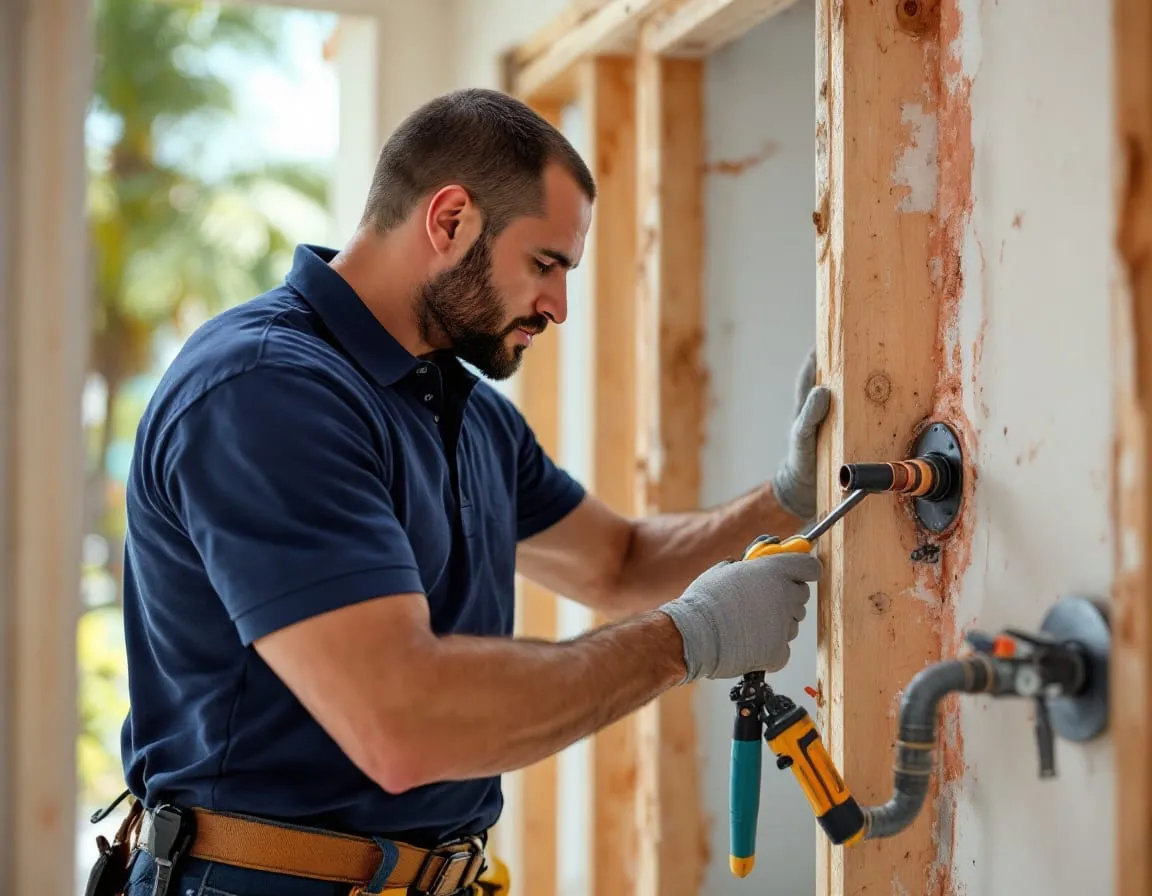
Because many South Florida homes route supply lines through the slab, a repipe often reroutes new lines through the attic or walls instead of re-trenching the same slab path.
Frequently asked
That depends on where the failures are concentrated. An on-site assessment determines whether a targeted section addresses the problem or the whole system needs it.
It varies by the size of the home and how the lines are routed. We give a specific timeline once the scope is set.
In most cases, water service is only interrupted for short windows during the transition, not for the full duration of the project.
The plumbing side of the project is ours; where drywall needs to be opened to route a line, we can coordinate that access and leave it ready for patching.
Related
A few related services often come up in the same conversation.

Ready when you are
There is no charge for the estimate. When a pipe will not stop, call rather than type.